"If given the target will be the monarchy" RABAT - Maati Monjib is Professor of History and Politics in the Maghreb at the University of Rabat (Institut des Etudes Africaines, Université Mohammed V-Souissi) and Chairman from 2008 to the Saban Center for Middle East Policy (The Brookings Institution, Washington, DC). In addition to being one of the founders of the Centre d'Etudes et de Ibn Rochdi Communication (Rabat), is working with the historical and popular monthly Zamane .

In 1992 Professor Monjib published one of the first academic study on building of absolute monarchy in Morocco. The book, The monarchies
marocaine et la lutte pour le pouvoir: Hassan II face à l'opposition nationale, de l'indépendance à l'état d'exception (Paris, L'Harmattan), is still banned in the country. Building on the analysis of his work, Maati Monjib reconstructs the political framework of post-independence Morocco and the evolution of the power system in the North African state to this day. Describes the power relations that bind the monarchy of Mohammed VI to the current political landscape, and discusses the role played by the Islamist forces e dalla società civile, in un paese che si prepara all’esplosione del dissenso (appuntamento fissato per il 20 febbraio).
Intervista a Maati Monjib (Rabat, 14 febbraio 2011)
Signor Monjib, cosa ha scritto di terribile nel suo libro “La monarchie marocaine et la lutte pour le pouvoir” da non poter essere letto qui in Marocco?
Per prima cosa, nel mio libro ho trattato la monarchia marocchina come un normale attore politico, desacralizzandola, e facendovi riferimento senza troppa riverenza. Altro motivo della censura è che all’interno del libro ci sono delle verità storiche documentate, non gradite ad Hassan II, showing that the sovereign is able to assume absolute power, eliminating the other political actors present in the post-independence years, such as the nationalists, communists, trade unionists and independent intellectuals. In the book, I also speak of the corruption with which the Makhzen (synonymous with monarchical system, ed) has built its own sociology of power, distributing the land among the colonial most devoted servants. In addition, the monarchy marocaine et la lutte pour le pouvoir is an academic work, not a political pamphlet, which has total legitimacy being based on documents, testimony, speeches and newspapers of the same Hassan II, and not on speculation theoretical. For example when I say that Hassan II feared the school and education, carry his own words. Education in the modern sense of the word represented a political and ideological threat to the throne. In a speech to the nation on March 25, 1965, following the social unrest that erupted in Casablanca, Hassan II has clearly stated, referring to the Moroccan people, "was better than all of you were illiterate, there is no greater danger to the was that the presence of intellectuals. " You should know that when the old King always said the truth was angry.
What were the measures taken by the regime to combat " risk education "?
In the sixties we had the best university system in Morocco in Africa (excluding South Africa's white). Since 1965 the level of teaching is collapsed. Officials of the scheme have got the message launched by His Majesty. The only towns spared by this process of regression were technical schools. The system was still need well-trained cadres, could not afford to be incompetent technicians. The solution, in this case, was the militarization of schools. For example, a school for engineers at Mohammedia has become a military institute. Even today, those who frequent and an engineer, but allo stesso tempo un graduato. Così viene inculcata nella sua mente l’ideologia del regime, l’ideologia della sottomissione al potere. Quanto alle università, le hanno semplicemente lasciate deperire. Alcune materie, come la filosofia, l’antropologia e la sociologia, erano considerate i nemici naturali di uno Stato assoluto in piena epoca moderna. Così nel 1972, dopo una fase diciamo di preparazione, hanno chiuso i dipartimenti. E non per motivi economici, del resto lo hanno detto ancora una volta in modo chiaro: “la sociologia e la filosofia formano solo dei sovversivi e degli ignoranti”, scriveva Hassan Alawi, cugino del re e responsabile del quotidiano monarchico Le Matin . Non tolleravano che students formed a critical spirit, the foundation for the modernization of values. Again, Hassan II was believed that modern education was an ideological threat to the traditional system of power which he had built around him.
How has, if we can speak today of change, the regime's attitude towards education?
The attitude of the regime has changed over the decades, depending on the existing conditions. In the eighties, for example, appeared the departments of Islamic studies. The monarchy has tried to follow the Saudi model, to prevent the evolution of society towards the modern cultural, political and social. He tried to stem this way the need for freedom, democracy and respect for human rights remained in the population. Half of the students in the twenty years '80-'90 were enrolled in the courses of Islamic Studies, which advocates a recovery of traditional values \u200b\u200band authoritarian Islam. During this time the left has largely disappeared from the University el'UNEM (National Union of Moroccan students) ended up in the hands of Islamists. The result was the spread of Islamic ideology in all its forms and variations. When Islam has become even more dangerous to the regime, compared to the opposition Left and cultural modernity, were reopened the departments of philosophy and social sciences since the late nineties. This shows that the state has a constructive strategy, does not propose a model of society, but only a set of tactics to deal with the immediate manifestations of dissent.
Referring to the reign of Hassan II (1961-1999), she spoke of absolute monarchy. You can specify this definition?
When I speak of absolute monarchy, I am not referring to the legal sense, but purely an evaluation policy that reflects a reality. In scientific language we speak of monarchy absolute in the absence of a constitution. In the Moroccan case, however, the years ranging from independence (1956) drafting the first constitution (1962) can be considered a period of constitutional monarchy in the absence of the basic requirement. It 's a question of power relations. At the time, the national movement (which were also included socialists and communists) had succeeded in breaking the king Mohammed V. When the movement has been weakened because of internal divisions and phagocytosis of his paintings in the structures of the state, the balance of power has changed in favor of the Palace. So the absolute monarchy, ironically, began with the promulgation of its constitution, that legitimized the powers of domination and control of the new king Hassan II. The situation remained unchanged until the early nineties.
Some analysts argue that the beginning of the nineties marked the beginning of democratic transition in Morocco. E 'agree with this assessment?
No. That started in the nineties is not a democratic transition, than the manifestation of a trend "democratizing." When we speak of democracy refers to the redistribution of power to the elected bodies, which still has not taken place in Morocco. There was however a process of liberalization in the political sense of the word. More freedom, less repression and torture in relation to "years of lead" and less control of the word. A process from the beginning of the nineties went on growing until 2003 (the Casablanca bombings), when the trend reversed and began a slow decline.
What is the reason this "liberalization" initiated by Hassan II after the terror fed during the years of lead?
Basically you have changed once again the balance of power. Hassan II had made a monumental error, had not realized that the company had evolved, although it was regrettable education, and that the media (defined as channels of media coverage in general, not the newspapers or on national television) had changed. The concrete manifestation of this came in 1991 when we saw the first Gulf War. The Moroccans were radically pro Iraq, a country emotionally involved in the Arab Palestine and the suffering caused by the West, and the king, who had supported the U.S. attack, he found himself totally contradicted by his people. In Rabat at least 500 thousand demonstrators marched peacefully, most of that city's population at the time. Hassan II had banned the march, saying: "I will not tolerate any demonstration or pro Iraq or against Iraq. The monarchy had to change its mind and began to fear that things were going to get out of hand. Changed the balance of power between the monarchy and the people, began a period of political openness, political liberalization, as I said before, which resulted in the government alternation (1998-2002) led by Socialist Prime Minister Youssoufi. In practice, however, the king has kept his absolute control now. Mohammed VI is in fact Head of Government Summit of the judiciary and armed forces, as well as Amir al- muminine , "Head of believers" and therefore a religious leader. The hopes of democratization arose in the early nineties have clashed, well before the attacks in Casablanca, con la guerra civile algerina e la minaccia di destabilizzazione del paese.
Qual è la sua valutazione, sul piano politico, dei primi dieci anni di regno Mohammed VI?
Dal 1999 ad oggi, la dialettica politica marocchina, che era rimasta viva e feconda pur negli anni della clandestinità e della repressione violenta, è praticamente morta. Con il governo di alternanza quella che era l’opposizione tradizionale, cioè Istiqlal (il partito nazionalista), USFP (Unione socialista delle forze popolari), PPS (Partito del progresso e del socialismo), PADS (Partito dell’avanguardia democratica e socialista), è stata integrata nelle strutture del regime, senza che ciò comportasse una maggior condivisione del potere decisionale, sia a livello legislativo che esecutivo. I singoli rappresentanti politici sono stati assorbiti negli ingranaggi di una gestione dello Stato che resta prerogativa esclusiva della monarchia. Sono entrati a far parte del governo ed hanno dimenticato le rivendicazioni iscritte nei loro stessi programmi politici. Per esempio l’USFP, nel 2002, ha rinunciato alla richiesta di una modifica della costituzione in senso democratico pur di continuare a far parte dell’esecutivo. Una rivendicazione che il congresso aveva imposto all’ufficio politico. Per questo motivo i partiti si sono svuotati di peso e di significato nell’ultimo decennio. Sono diventati delle scatole prive di contenuto, devoid of ideas and social and political projects. They have lost popular support and legitimacy in the eyes of the people who see them as bureaucracies that serve the power system to sit at her table.
The legislative elections of 2007 are a clear sign of this political vacuum, is not it?
Without doubt, since only one Moroccan in five among those eligible has expressed a preference policy. It 'obvious, the population knows that the decision-making power is in the hands of elected bodies but elsewhere in the Palace. And the building is not put to a vote. This situation, however, is even more dangerous for the regime, found with bare shoulders. Politicians are failing more than one filter between the sovereign and the people. This means that in case of a popular uprising, the monarchy would be the target of the insurgency.
You mentioned "lack of ideas and political and social projects" in the historical opposition parties. But the forces of the Moroccan Islamist ideas and projects seem to have indeed.
This has undoubtedly strengthened the Islamists, both the PJD (Justice and Development Party, moderate Islamic education, ed) who sits on the benches of parliament as the Justice and Charity Association (a move not recognized by regime that denies the legitimacy of the Alawite dynasty, ed) which has a large following among the population. They are the only today to embody in the Moroccan political scene a real feeling of opposition. Who is critical of the regime or vote PJD, except for small parties of the radical left, or is close to the organization of Yassine. Let me give an example. The major neighborhoods of Casablanca or the northern cities like Fes, Meknes and Tangier, who voted in the nineties USFP now vote PJD or boycott the elections, as sought by the Justice and Charity. The USFP has become instead an almost rural-based party, are the chiefs to support him, those who have individual and clan interests to defend.
So, to return to his previous question and end this long analysis, the apparent result of the first ten years of the reign of Mohammed VI is the disappearance from the political opposition of secular and inherently democratic, and the weakening of the socio -political in itself.
E 'to overcome this weakness that the system has intervened directly in political affairs by imposing his most trusted man to create a new party?
WFP (Party of the authenticity and modernity) is the tip dell'icebeg the product and perhaps more worryingly, in terms of political sociology, the reign of Mohammed VI. With the creation of WFP, the monarchy has tried to channel the support of a party elite that was not included in the training policies "historical" take the opportunity to shape the new party in a totally devoted to the system. The second reason for the creation of the PAM is its anti-Islamist and anti PJD. However, it is not an ideological position that the WFP is waging war to PJD and the association of Yassine. Fouad Ali El Himma, adviser to the king and former number two of the Interior Ministry, he simply responded to the input to counter the strongest party, the only one who still enjoys wide popular support, and criticizes the regime.
These days we've come to talk about "benalizzazione" of Morocco. Do you think that in this sense can venture a comparison PAM-RCD?
WFP can be considered an organ of state, the spokesman of the common monarchy and in this sense was conceived on the model Tunisian RCD. Keep in mind that was created in August 2008 and became the first ten months of the kingdom, gaining the majority of local governments (in local elections held in June 2009, ed) and seats in the upper house. When collaborating with Le Journal Hebdomadaire I written now here is a new symptom after the merger of the national economy in the hands of the regime el'addomesticamento the press, "benalizzazione of the country. It is false and analysis of context, on the contrary. Although obvious differences between the two countries, the intention of the monarchy was clear even before the official creation of WFP, the emergence of the Movement for all Democrats promoted by the same El Himma. This party is to defend the Alawite autocracy trying to gain a monopoly of political representation and ideological practicing a shameless opportunism.
What are you referring when he speaks of opportunism ideologico?
Riprendo quanto stavo dicendo poc’anzi rispetto alla funzione anti PJD e anti Yassine del PAM. Il partito di El Himma, da una parte, ha mobilizzato le genti contro gli islamisti, recuperando i laici, i vecchi militanti di sinistra e la borghesia liberale. Dall’altra ha sempre sostenuto la Commanderie des croyants , lo strumento che legittima il primato del re in materia religiosa (art. 19 della costituzione, ndr), continuando a sacralizzare l’istituzione monarchica e ad invocare la gestione tradizionale del potere. Ma a mio avviso non c’è un sistema più islamista del nostro, dove il capo politico è allo stesso tempo vertice religioso. Questo è opportunismo ideologico. Assuming, in the coming elections will affirm the Socialist Party, the WFP would automatically become anti socialist. The only ideology WFP is the preservation of the status quo plus a hegemonic will, which could benefit from the political vacuum.
So the PAM can be considered the legitimate fruit "chameleon-like tactics used by the monarchy has mentioned before?
Yes Opportunism WFP merely reflects the opportunism of the monarchy itself, which becomes liberal, Islamist or nationalist as appropriate and convenience. When the king wants to focus its criticism and its pressure towards a political horizon particularly strong and assertive, then creates a party with an ideology determined ad hoc, to go to war on his own ground. The history of post-independence Morocco and teaches us in this regard Mohammed VI forms part of the full continuity with the past. In the sixties, when the weight of an Islamic-conservative nationalism was dominant, Hassan II launched the FDIC (Front for the defense of constitutional institutions), a party whose pro-Western leader, Ghedira, spoke more French than Arabic, and openly stated liberal. In the seventies, when the current union and socialist was the strongest, the regime has created a liberal party (RNI, Grouping National independent). A monarchy really eclectic, no doubt about it ...
In the current political vacuum, what is the remaining space for the expression of dissent?
Between 2007 and 2009, was the press play a real role of opposition. Newspapers like Tel Quel, Le Journal Hebdomadaire and Al Massai in origin, were the only voices of dissent secular and pro-democratic, so have recently been awarded by the regime. The independent press has been under pressure and a tough economic boycott, or so that has been forced to close, as in the case of Journal or Nichane , or had to reinvent its editorial policy in order to survive, as did Al Massai now definitely is doing and how Makhzen Tel Quel after the departure of director Benchemsi. But the disappearance of the independent press, was soon remedied by the use of new media channels of free expression: the Internet and its tools of contact, such as YouTube, Twitter and Facebook, as well as blogs and online newspapers, where Moroccans are increasingly active. I would say that the Internet has become the first area of \u200b\u200bfree exercise of citoyenneté (a term that indicates an awareness of rights and duties of data from national and more subject, note) in Morocco.
What role this plays in the Moroccan civil society?
The work of associations, or rather of some organizations such as the Moroccan Association for Human Rights (AMDH), is certainly intended to fill the political vacuum that blocks the development of the state. This is because in the last twenty years has been granted a work space for civil society, including the openly pro-Democratic, which until now has served a little 'valve-protection scheme. The pressures within the landscape associations in general are lower than those condizionano il contesto politico. Questo perché un partito, in quanto tale, ha l’obiettivo intrinseco alla sua condizione di prendere il potere. Dunque tutte le formazioni di opposizione, anche quelle minori, costituiscono in linea di principio un pericolo per il sistema. Le associazioni invece perseguono finalità civili e non politiche. Ma quando il loro attivismo assume una valenza nettamente politica, scatta la repressione, come è successo nel giugno scorso all’AMDH, di cui alcuni membri del governo hanno chiesto a gran voce la dissoluzione.
In un contesto nordafricano scosso dai sollevamenti popolari (Tunisia, Egitto, Algeria), quale pensa che sia lo scenario che si rifletterà, short or long term, in Morocco?
For the moment I do not believe in a repeat of the Tunisian model in Morocco or Egypt. In other words, do not think it is possible to present a revolution. There is the social frustration, also the result of endemic unemployment, which official figures are very distant from reality. At least one third of graduates are unemployed, and what is worse, with no real prospects for the future. There is a desire for change and democracy, but the scheme is in any case better equipped to handle a crisis than the apparatus of power of Ben Ali. The process of "liberalization" policy which I have mentioned before, in Tunisia was not the slightest trace. In Morocco, the opposition was cleared but not yet destroyed. I think that when faced with a challenge, the monarchy could reactivate social safety valves (associations and some political parties) that would, in theory at least, to channel dissent. Mohammed VI could then get away with some small reform. This short-term. In the longer term however, if the king does not grant immediate openings and the WFP project were to materialize, the scenario is quite different. But, frankly, I think that the Palace is already using the experience of Tunisia and Egypt. Mohammed VI will abandon the path of one-party and will break the umbilical cord that ties him to the WFP. At this time, not to, it would be too dangerous for its own interests.
In case of dispute, which could be the reaction of the military?
The military is another tool in the hands of the monarchy if he is facing a strong challenge. The Palace would have nothing to fear from the military. Part of the official is corrupt and the rest after the two coup attempts (1971, 1972), the message from the Hassan II military leadership was clear: "Nurture and let go of politics," which translated means " well let the corrupt, basta che non mi mettiate più i bastoni tra le ruote”. Le forze armate, che non a caso si chiamano “reali” (FAR, Forces Armées Royales), nell’ipotesi di scontri violenti non prenderebbero le difese della nazione, quindi del popolo, come successo in Tunisia e in Egitto, ma si posizionerebbero a protezione del sovrano e del suo apparato.
L’associazione islamica Giustizia e Carità ha già appoggiato ufficialmente la manifestazione del 20 febbraio. Come pensa che si muoverà l’organizzazione di Yassine, ben radicata nella popolazione e da sempre contestataria della monarchia alawita?
Nel caso di una rivolta della popolazione urbana, as might occur on 20 February and in the weeks to follow, and followers of the Liberal Youth Yassine would play an equal partner. Certainly the Islamists will not try to manipulate the movement of a challenge to show off, because they know it would become counter-productive, especially in front of Western public opinion following the events in the Middle East with fear. In addition to the support of Islamic protest, as well as justice and charity, could come from new generations of the PJD, much more open and democratic than the founders of the party. The new generation can be understood easily with people who think differently but have the same goals: democracy, redistribution of wealth in the country, respect for the dignity of the Moroccan middle, the end of a system that oppresses them and humiliates them with its laws and kissing (in reference to baya, the obligatory act of devotion to the sovereign) . The Moroccans have had enough of being labeled and ridiculed by neighbors as the Algerian "kisser of hands."

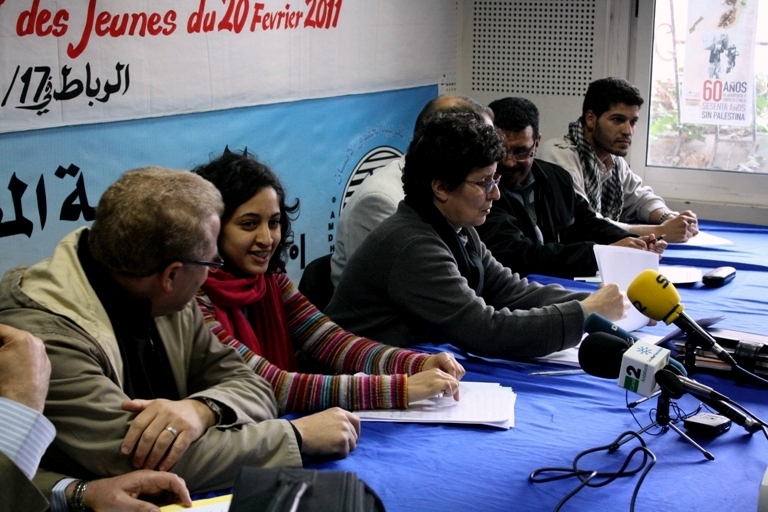
 Bouchua Mehdi, a student at the University Cadi Ayyad of Marrakech, returns to the fate to be reserved for Mohammed VI: "the movement, made up of different groups of young people appeared on Facebook, does not have a unified position on the matter. The claims to offer more shared a parliamentary monarchy modeled on English or English, but others openly call the transition to a Republican. In any case, the end of the monarchy monopoly on political and economic life of the country is a priority for everyone. The king should not govern, who commands must be chosen by the people in absolute freedom. " Even Mehdi, twenty-three years, is part of the Movement February 20, launch da alcuni suoi coetanei attraverso il social network durante i primi giorni della rivolta egiziana. “Il gruppo più numeroso si chiama «Il popolo vuole il cambiamento» e oggi conta quasi 14 mila aderenti. In totale siamo più di 20 mila su Facebook, compresi gli infiltrati che si iscrivono per insultarci”. Il giovane universitario abbandona la sala conferenze e si siede ad uno dei computer messi a disposizione dall’associazione. Sulle pareti della stanza, una sequenza di poster testimoniano l’attività instancabile dell’AMDH, che da oltre trent’anni si batte per la difesa dei diritti e delle libertà in Marocco. Accanto ad una foto di Ben Barka, oppositore del regime assassinato dai sicari di Hassan II nel 1965, a map of Palestine remembers the sixtieth anniversary of the Nakba. "They spread montages where the leaders of the movement are portrayed with dozens of bottles of wiskhy. We have described how the hippie drug addicts, non-Muslim enemies of the country with the Polisario who plot to sow chaos in the country, "says Mehdi pointing to the screen. Displkay on the list of contributions, including a derogatory comment Meryam signed (the accounts are created under a pseudonym): "You're only godchildren Algeria and Mohammed Abdelaziz (the head of the Polisario Front, ed).


