Saturday, February 12, 2011

Metastasis More Condition_symptoms

Hamami Jilani, a trade unionist "dissident" said Tunisian

TUNIS - Hamami Jilani, in addition to having served as Secretary-General of the PTT officials (trade association, post and telecommunications, which is part of the General Union of Tunisian Workers - UGTT, ed), is one of the founders of the Communist Party of Workers Tunisia (PCOT). Syndicalist "dissident" and political opponents during the regime of Ben Ali, speaks about the collusion between the Hamami UGTT former dictator and said his fight within the union is also a member today.

Interview Jilani Hamami (Tunis, 29 January 2011)

Jacopo crabs: In his history of opposition politician has ever had the experience of prison?
Jilani Hamami: Yes, twice, in 1984 and 1997. In both cases the arrests were not due to active politics, but my work as a trade unionist. The first time, nel 1984, avevo lanciato uno sciopero dei dipendenti della posta e del settore telecomunicazioni durato dieci giorni. Dieci giorni di paralisi, in cui gli uffici postali si sono fermati e lo Stato ha dovuto chiedere l’intervento dell’esercito per assicurare il servizio. Alla fine della protesta sono stato arrestato. Rischiavo una condanna a quattro anni di carcere ma, grazie al sostegno delle organizzazioni sindacali internazionali, le accuse sono state ritirate ed ho potuto lasciare la prigione dopo solo tre mesi, durante i quali non sono mai stato maltrattato.
Nel secondo caso, nel 1997, ero il rappresentante nazionale della federazione PTT e come tale membro della Commissione amministrativa dell’UGTT. Ero assolutamente contrary to the approach taken by the Executive Office. The Secretary then, Sahbani Ismail, was undermining the activities of the union, the efforts from its base and the entire democratic movement in Tunisia. He was so compromised with the regime that Ben Ali called him "the minister of labor." In addition there was no transparency in the management of financial resources dell'UGTT. Along with other trade unionists fed up with this situation, we circulated a petition calling for a national council extraordinary that the direction we wanted was discouraged. But Sahbani went to the police and accused us of wanting to create unrest in the country by attacking its official establishment and circulating false information about him. It was once again the involvement of international organizations, not just unions but also to human rights, to stop the process. Released from prison a few months later, I still found myself without a job and paid from my post of national secretary of the federation PTT. It took a hunger strike in front of the seat dell'UGTT, who joined my family because I could obtain another job and I could return the passport, which had been deprived during the nineties.

JG: In this second arrest has undergone special treatment by the police?
JH: No, they had no reason. We have taken our responsibility and we have never denied that he had circulated the petition. On the contrary openly were defending our point of view, so there was no need to torture or ill-treatment, leading to a confession. It was an internal problem of the union, the police had nothing to do. But then during the Ben Ali regime the UGTT, as some opposition parties alleged, played a key role in stifling any need for change and ensuring the country's stability and social peace so celebrated by the former dictator.

JG: In spite of this she is still part dell'UGTT?
JH: Yes, I am still a member dell'UGTT. But this does not mean you approve of his top choices. Inside the center there are many trade union federations and regional divisions that are still dissenters than to the executive board. And then there are the political representatives, as the same PCOT or Nationalist Party, independent activists and individuals who seek to lobby for a change. I'll give you one example. In July 2010 we created the Charte et Démocratique Syndicale militant, a document written by people like me, wants to settle the score with a management benaliana mafia and the union. A deeply anti-democratic management, which has always included several prominent progressives at the top.

JG: What reactions have followed your initiative?
JH: The police has started the persecution since August. We were put under surveillance. Stalking continues throughout the day, cars waiting in front of the door at night. The phone control, as well as e-mail. A system designed on purpose to sow panic and create a vacuum around you. In this way, no one wants to call you or visit you. At the end of the month, they took me to the police station with the excuse of having caused an accident. In fact I was to have been buffered. Mi hanno tenuto dentro ventiquattrore e poi mi hanno lasciato andare senza accuse. Tutto ciò per impedirmi di partecipare ad una riunione clandestina dei fondatori della Charte prevista quel giorno. Ad ottobre sono stato convocato di nuovo in commissariato: la polizia voleva costringermi a firmare un verbale in cui dichiaravo di far parte di un’organizzazione illegale. Ho saputo poi che era stata la direzione centrale del sindacato a dare le informazioni alla polizia. I gran capi cominciavano a temere che la nostra iniziativa riscuotesse troppo successo all’interno dell’UGTT e così ci hanno venduti.

J. G.: Dopo la rivoluzione i vertici dell’UGTT sono cambiati o sono sempre gli stessi?
JH: It's always the same. Before the fall of Ben Ali was elected not provided an extraordinary congress that would change the regulations to allow national representatives to be able to reapply at the helm of the union (the elective conference was scheduled in December 2011). We, the promoters of the Charter, we were opposed. Now the situation is different, or at least it seems. The old guard is on the defensive because he knows that it can not compel union members to go along with the threats, as he had done in the past. The base dell'UGTT has raised its head and no longer afraid of the Executive Office. I think the next Congress, where it will elect the new instances, will be decisive for the credibility and perhaps the very survival of the union.

JG: What is the position dell'UGTT compared to the transitional government?
JH: First of all, we must distinguish between the "official" by the media and the "true position". Just this week the leaders dell'UGTT have a dirty game. Jrad The Secretary-General has accepted the deal offered to him by the interim president Fouad Menbazaa without the support of the Administrative Commission (the body with representation from more extensive), as it provides the statute. Have melted the government to try to stop the protests, but on the condition of maintaining the new Prime Minister Mohamed Ghannouchi training and three other ministers in office. Formally, the national press said the UGTT supports the new transitional government within the union but in reality there are different positions and the majority of the Commission does not agree either with the Secretary Jrad, nor with the new Executive Ghannouchi. Many of the members dell'UGTT continued the protest and stayed together to the casbah "caravan" until yesterday (January 28, the day of the violent eviction carried out by the police, ed.) They even witnessed the death of three people at the offices of the police.

J. G.: E il suo partito cosa pensa del governo Ghannouchi?
J. H.: Il governo Ghannouchi non ha alcuna legittimità e sta facendo ben poco per ingraziarsi il sostegno della popolazione. Nella nuova formazione, fresca di nomina, ci sono ancora membri dei vecchi clan di potere. Per esempio il ministro dell’Interno Ferhat Rajhi è un giudice, ex RCD, conosciuto nel foro per la sua corruzione. Non abbiamo la minima fiducia in questi loschi personaggi.

J. G.: Quali sono ora le priorità per il PCOT?
J. H.: In questo momento, il primo passo da compiere è la dissoluzione dell’RCD, un partito a struttura e vocazione chiaramente fascista. Poi si deve aprire un confronto tra tutte le parti politiche e sociali per la creazione di una costituente, che lavori in parallelo ad un governo provvisorio ripulito, per riformare la legislazione del paese. Questa non è solo la posizione del PCOT, ma di un’intera coalizione di forze democratiche riunita sotto il nome di Fronte 14 gennaio, di cui fanno parte i partiti di sinistra, i nazionalisti, alcune frange dell’UGTT e le organizzazioni della società civile (Lega tunisina per i diritti umani, Movimento per la dignità popolare, l’associazione Femmes democrates, la Lega degli scrittori liberi e l’associazione contro la tortura).

JG: Can you briefly summarize the history of his party under the regime of Ben Ali?
JH: The party was created January 3, 1986, to commemorate the lifting of the Tunisian people, occurred two years earlier, the "bread riots" (January 1984). The president was still Habib Bourguiba. Since then, training has never been formally recognized by the regime and remains illegal today. In 1988, the year of the fake opening to the pluralism of Ben Ali, had applied for legalization, but it was rejected. The next year, following the success of Annadha elections, was voted a new law on political parties and from that moment was the total closure of political space, followed by the arrests in the early nineties and the beginning of physical repression of our militants. About three hundred activists ended up in prison between 1990 and 1991. After Annadha the PCOT is the political formation that has most suffered from the war declared by Ben Ali in opposition.

JG: He cited the example of Annadha. The paintings of the PCOT, such as the Islamist party, fled abroad to escape prosecution?
JH: No, ours has been a conscious political choice. We decided not to leave the country, even if forced, in some cases, to go into hiding or in jail. Samir for example (a member of the Communist Youth sitting at our table, note) he hid for three years before being arrested by police in 2002. For his political activities at the university was sentenced to nine years in prison, along with the secretary of the Hamma PCOT Hamami, but spent only one and then was released.

JG: You spoke earlier about the "alleged opposition parties." He was referring to a case Attajdid? What is your position on the "comrades" who are now part of the executive transition?
JH: Attajdid is not a leftist party, the rest has not even kept the name. They are recycled old Tunisian Communist Party, renamed Attajdid after the fall of the Soviet bloc, who have erased all references to the socialist ideological framework and the system will be tacitly allies Ben Ali. The former secretary, Mohamed Harbal, was promptly sent to the European Parliament to defend the regime from charges of violation of human rights and fundamental freedoms that were addressed. He was a dictator game, saying: "Your voice criticism of Tunisia are unfounded since I, a member of an opposition party, are here today to talk about." Attajdid has brought together the Tunisian democratic movement only after the Congress of 2007 which replaced the old leadership and has appointed Ibrahim secretary. Nevertheless, they were the only non-RCD party to be present in parliament, which suggests that since Ben Ali in Tunisia were not the elections to ensure access to the assembly, but the will of the regime, which came even individuals to decide the election.

JG: What do you think instead of Annadha participation in the political debate that seems to be opening in the country?
JH: Annadha has experienced two different phases in its history. In the first period was decidedly undemocratic and brought an Islamic government set on the principles of sharia. In the second phase, after the repression suffered during the eighties, the formation of Rachid Ghannouchi has changed strategy and objectives, adhering to the view of gradually democratic resistance, without sacrificing the Islamic powers. A shift that was officially sanctioned in the eighth party congress held in London in 1998. Inside, there are still different factions, some more moderate and more radical, however Annadha joined the platform calls for democracy promoted by the Movement on October 18.

JG: What is it about?
JH: In 2005, held in Tunis World Summit of communication, a huge insult view the complete violation of freedom of expression in the country. On the sidelines of the conference, a dozen activists of the democratic movement, including the Hamma Hamami PCOT, Najib Chebbi of the PDP (Democratic Progressive Party), some members of Annadha and other independent, have launched a hunger strike that drew ' international attention. After the protest, which lasted about twenty days, it was decided to form a sort of coalition, called precisely Movement October 18, demanding the recognition of rights and fundamental freedoms in Tunisia. At the same time, within the coalition, opened a debate on the priorities to be followed to start the democratic change the country. The platform that came out, shared by Annadha, recognizes the need to distinguish the state from religion, then the principle of secularism as the foundation for democracy. But the movement was short-lived. Gone the international spotlight, police in Ben Ali regained the freedom of his duties and discussions broke down.

JG: Annadha has, in its view, full political legitimacy?
JH: Absolutely. It is a national public opinion and of Tunisian society, would be wrong not to take into account . Once embarked on the path of democracy, freedom of expression and participation should be attached to all regardless of political ideology professed. In 1991, when they began the arrests against members of Annadha, me and fellow party we oppose and denounce the myopia of the repressive policy of the Government and supported by some opposition forces. The people have the right to choose freely.

JG: So for her, secular and communist militant, Annadha not a threat?
JH: I believe that if the people Tunisia will live a true democracy, not persuaded by the argument will never leave the political-religious Annadha. If you continue to exclude and repress Annadha, we will only increase his strength and sympathy collected among the population. The freedom and democracy, participation in political life is the best way to prevent the party Ghannouchi face a vacuum in the country. Sure, the financial resources and support they have now will allow him to get a good result in the case of regular elections. But this was only a momentary reflection, also due to the legitimacy gained by the movement in the past. The Tunisian people are not fundamentalist. It 's a people of faith, but open. He well anchored itself in the values \u200b\u200bof secularism and gender equality. In partnership Fammes democrates, for example, there are many veiled women who make the prayer five times a day. None of them would ever be willing to vote for Annadha.

Tuesday, February 8, 2011

Fibromyalgia More Condition_treatment

Back in Sidi Bouzid, Tunisia epicenter of the insurgency (and Arab)

It 's been a month after the escape of Ben Ali and the conquest of Carthage. Almost from the beginning of two lift, which broke out in the remote (and hitherto unknown) of the interior regions, while the transition to democracy struggles to take its first steps. Back where it all started ...
The long tongue of asphalt that cuts in half a lunar landscape, flat and arid, it stops just before entering the city. The road disappears into a path littered with potholes and stones, which jolts the car for a couple of miles into the heart of the village. "Raise your head, you're in Sidi Bouzid", is written next to the monument at the center of the square on November 7, renamed by the people "square Mohamed Bouaziz. The photograph of the martyr covers the shapeless sculpture, erected to celebrate from the past regime's rise to power of Ben Ali. Ousted the dictator, new heroes rise to the memory of the revolutionary Tunisia. First of all the young peddler di ventisei anni che il 17 dicembre scorso si è dato fuoco di fronte alla sede del governatore regionale, a pochi passi dalla piazza. Al gesto di Mohamed Bouazizi è seguito qualche giorno dopo il suicidio di Neji Felhi, gettatosi sui cavi dell’alta tensione al grido “basta miseria e disoccupazione”. Due episodi che hanno sollevato il coperchio di un sistema corrotto e repressivo. Due episodi che hanno infiammato Sidi Bouzid e i villaggi circostanti, scatenando la rivolta di una popolazione marginalizzata, consumata dalla hogra e stanca degli abusi delle autorità.
“Siamo tristi e allo stesso tempo fieri”
La casa di Mohamed Bouazizi è nascosta tra i vicoli sterrati della Cité Ennour-ouest. Minuscole baracche in argilla, appiccicate l’una all’altra, si susseguono anonime nel quartiere popolare, labirinto fangoso alla periferia occidentale della città. Dietro alla piccola porta di metallo, la famiglia Bouazizi è raccolta attorno al dolore della madre Manoubia. La donna giace distesa su un materasso appoggiato per terra. Rannicchiata, il volto è quasi nascosto sotto la spessa coperta di lana. Si intravedono appena gli occhi, di un azzurro pallido, e una mano che strige debolmente un sebha (una sorta di rosario) di legno. “E’ molto malata, dalla morte di mio fratello non è more out of the house, "says Basmah, fifteen years. In addition to her, living in badly lit, and there are Leila Samia, younger sister of Mohamed, and the small Zyad, eight years. Samia has black hair under the hijab, which stands east of cutting his eyes and beautiful facial features, nicked in the right cheek by a deep scar. And 'her to speak: "we live a state of emotional confusion. We are sad and proud at the same time. My brother is gone, but his act has changed the destiny of our country. " The death of the young peddler seems to have left a huge void in the family Bouaziz. "He was cheerful and polite. In cities all loved him, " Samia continues, nineteen, the last year of high school where he is following a course in Italian. "In class he was brilliant, he spoke French well, but finished high school he decided to quit school to help us. We buy food and pay the school, worried about our education. It was he who taught us to read to children. " With his work in the best day, Mohamed could earn from fifteen to twenty dinars (€ 8:00 to 10:00). Bought vegetables at dawn and then resold on the street with his cart. "He had presented many job applications in government and in public, never get a response. So he started working on the market. "

Il 17 dicembre scorso Mohamed Bouazizi si è visto sequestrare la merce e la bilancia da tre agenti della polizia municipale. Tra loro una donna, Fayda Hamdi, che lo ha insultato e schiaffeggiato, prima che i suoi colleghi finissero il lavoro a suon di botte. “Quella della licenza era solo una scusa. Quasi nessuno ce l’ha. Volevano estorcergli denaro”, tiene a precisare Samia. Per riavere la merce e la bilancia Mohamed avrebbe dovuto pagare trenta dinari, il guadagno di due giorni. Era questa la mazzetta corrente con cui i poliziotti arrotondavano lo stipendio nella Tunisia del “miracolo economico”, tanto osannata da Ben Ali e dai suoi sostenitori occidentali. Mohamed did not yield to blackmail. He protested, tried to recover the goods, then called the hearing to the Governor, in vain. Driven by despair and shame over the insult suffered, he poured gasoline and set himself on fire.
Bouaziz Mohamed died in a hospital in Tunis on January 3, after seventeen days of agony, because of the severe burns all over his body. At that moment the uprising triggered by his gesture in Sidi Bouzid had already infected the entire country was turning into revolution. Mohamed they have now become the symbol of a new martyr Tunisia is trying to close the accounts with the mafia and the old authoritarian regime. "I do not parlava mai di politica, non era un militante, ma amava la libertà e credeva nel rispetto”, ricorda la sorella Leila, ventiquattro anni e una laurea ottenuta da pochi mesi all’università di Monastir. “Appena la mamma si sentirà meglio partirò per la capitale in cerca di lavoro. Qui non c’è posto per me. Rimarrei ad ingrossare le fila dei disoccupati, come ha fatto a lungo mio fratello”.

Sviluppo a due velocità
Sidi Bouzid, cittadina di cinquantamila abitanti situata 265 km a sud di Tunisi, è da sempre terra di emigranti. Le misere condizioni di vita e le scarse prospettive di impiego hanno spinto migliaia di giovani a cercare fortuna altrove, in Europa quando era possibile, nelle città della costa o perfino nella vicina Algeria. Negli ultimi anni la disoccupazione ha raggiunto livelli insostenibili, ben lontani dalle cifre ufficiali riconosciute dagli organismi internazionali. “La media nazionale si aggira attorno al 14%, ma qui da noi il tasso di disoccupazione è almeno il doppio. Se prendiamo in considerazione solo la fascia dei laureati, supera abbondantemente il 60%”, afferma l’avvocato Allem Hachi, che prosegue la sua analisi sorseggiando una tazza di café au lait ormai decisamente fredda: “le generazioni più giovani sono tutte ampiamente scolarizzate. Oltre ai licei, recentemente, sono state aperte due facoltà: Agraria e Conservazione cultural heritage. But the decentralization of universities was not accompanied by the redistribution of capital and investment projects. "
The development model has condemned the Tunisian city of the Interior to a state of economic and social exclusion. The coastal towns and ports in the Sahel (Hammamet, Sousse, Sfax), which combines tourism and commercial activities alone account for 90% of national investment. The country seems to move at two speeds, in the complete absence of a smoothing of earnings. A Sidi Bouzid, Kasserine and Thala as nearby, we survive on agriculture and livestock, without a subsistence economy of the industrial and tertiary sectors. "The main resource is oil, olive oil, but no real processing plants. We still need a small artisanal oil mills, "said a farmer in his fifties named Mounir, owner of an old mill out of town. The three weavers present in Sidi Bouzid, employing several hundred girls, but the gains remain modest. "At the end of the month, the workers receive one hundred and fifty dinars (about eighty euro), while the interns difficult to arrive at percent. The lucky ones are the employees of Shtaif, a German factory of stuffed toys. They are recognized at least the minimum wage (two hundred and twenty dinars), "the lawyer said with obvious irony Hachi. For all graduate and undergraduate, is the dream of recruitment in public offices citizens, a vain hope, since those places were allocated on the basis of patronage for decades under the constant supervision of local authorities. According to 2009 statistics provided by the employment office, job applications submitted on 3899 3864 went unanswered. Outside the Café
Libya, in the dirt path as it moves towards the center of the country, a lot of bottles was stored along the edge of the roadway. The label is the brand name Celts, the former property of the beer family Trabelsi of Tunisia. If in Sidi Bouzid factories are scarce, not same can be said of the bar licensed to serve alcohol. "There are at least four, not counting the black market, a merger surprising for a remote town in transition," says allem Hachi. The city, in fact, is barely touched by the busloads of tourists in transit to the Roman ruins of Sbeitla and palm groves of Tozeur. The two hotels, except for the invasion of journalists in recent weeks, are perpetually empty. Hachi for the lawyer, the exceptional distribution of alcoholic beverages is another symptom of the malaise suffered in the region, as well as an attempt to numb the anger and the frustration of youths. Attempt failed, as Recent events have shown.

Demonstrations continue
In the former place on November 7, next to the sculpture which dominates the photo of Mohamed Bouaziz, was mounted a small tent. The sign hung at the entrance says "Popular Resistance Committees. One of those present, the Tunisian flag tied on the shoulder, said: "We are here since 14 January, it's time to stop the protest. There is still much to do and every day we go down to the streets to remind the parties and the new government will not be able to steal our revolution. " A Sidi Bouzid
the demonstrations continue. Around noon on the main road which crosses the city from north to south, nearly five thousand people gathered. Turn down the shutters of shops, closed the doors of cafes and restaurants. The soldiers observed the human tide that floods the streets of downtown without mentioning the slightest reaction. "Today there is a lot more people than on other days because the union has called for a strike," comes close spontaneously Ahmed, a schoolteacher in writing to the Union's regional workers. Hard to believe, since the working class in the country is virtually absent and the teachers are the only part of a union that had bowed his head too much during the regime of Ben Ali.
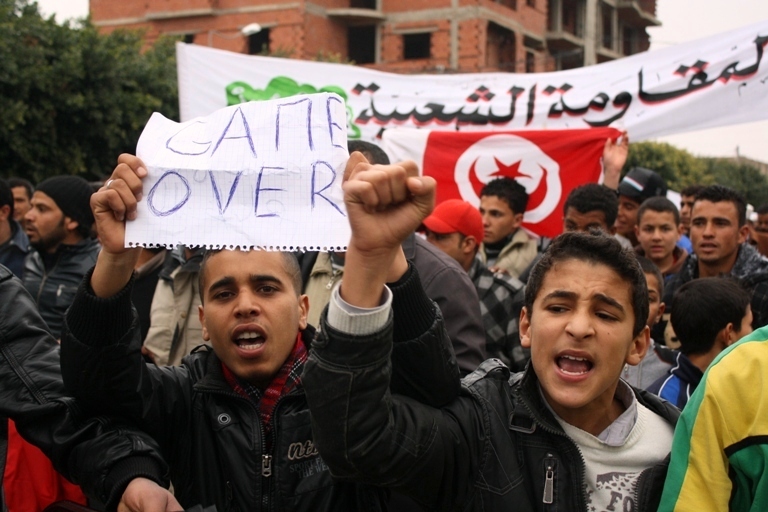
Sciopero o no, la manifestazione ha tutta l’aria della protesta spontanea, proprio come le rivolte di fine dicembre. Dietro agli striscioni non ci sono solo ragazzi, ma anche donne e bambini, intere famiglie. Perfino i “barbuti” sfilano accanto alle magliette del “Che” per chiedere la dissoluzione dell’RCD (il partito-stato dell’ex presidente), la partenza del primo ministro Ghannouchi e l’epurazione dall’amministrazione locale di tutti quadri compromessi con il vecchio sistema, in primis il governatore. Un uomo sulla trentina brandisce un foglio su cui ha scritto a penna un elenco dei corrotti: “il primo della lista ha fatto assumere le sue due figlie in una scuola senza che avessero il certificato di abilitazione all’insegnamento!”. La città non si fida delle promesse fatte dal governo di transizione. Con l’avanzare del corteo si moltiplicano le rivendicazioni. “Hanno annunciato un nuovo piano di investimenti per la nostra regione. Io ho portato mio padre all’ospedale qualche giorno fa e l’ho dovuto lasciare su un letto sporco e senza coperte”, ricorda Selim, venticinque anni e un fazzoletto rosso legato al braccio.

La marea transita di fronte alla sede locale dell’RCD. Due soldati e un rotolo di filo spinato ne impediscono l’accesso. Un manifestante chiarisce: “è the only building in town that was stormed during the days of lifting. " The courtyard is deserted and the signs of devastation are still evident. A little further on, reached the governor's palace, the march will stop and a picture of Mohamed Bouaziz is hoisted on the gate barred. E 'at this point the young man who sacrificed himself shahid, setting fire to a fuse that is still inflaming the Arab world from Algeria to Yemen. Someone says: "It is a disgrace, the authorities do not want it to grant compensation to the family. They did not even a phone call. In addition, the policewoman who humiliated him, slapping him and insulting the memory of his father, was neither charged nor tried. They just moved. " After a minute of silence that has silenced the entire Sidi Bouzid, the procession starts slowly with the choirs and Youyou women. The crowd of colorful posters and banners is poured back into the tree-lined street, unconsciously touching a bus stop called Al Hurra, "Freedom." The most beautiful image in this return to the origins of the revolution ...

Sunday, February 6, 2011

Autoimmune Condition_symptoms

Morocco: waiting for February 20 ...

In Egypt, the demonstrations continue to demand the departure of Mubarak. The Tunisia is again the scene of violence and clashes around the country. The population and the opposition parties contesting the appointment of new local government made by the executive confirmed. Saturday, February 5 in the town of El Kef, four people (two according to the Ministry of Interior) have lost their lives during an attack by the militias of the RCD (party of former president) to the police station. Meanwhile, Interior Minister Ferhat Najhi announced the suspension of the former ruling party "waiting to submit a formal application to obtain justice for its dissolution." In the realm
Alawite increasing tension ahead of Day of Action scheduled for next February 20. "To change the Morocco, freedom and democracy now" is the slogan promoted by Rachid Antide, a young surfer who launched the event on Facebook a week ago. The Moroccan Association for Human Rights organization Islamic Justice and Charity (not recognized by the regime) have publicly declared their support for planned events throughout the country. Meanwhile, increasing signs of a possible infection of the riots that erupted in Tunisia and Egypt. In recent weeks there have been four suicide attempts. Last February 1, when a young teacher set himself on fire in front of the Ministry of Education. In recently there have been dozens of injuries and accidents in the city of Fes, where the Marxist student organizations had called a protest march repressed by the police.


Why Morocco trembles
The weekly Tel Quel (No. 459, 5-11 February 2011) has gathered the voices of the main representatives of the Moroccan civil society. Here are the reasons why Morocco should not feel protected from the "contagion" Tunisian and Egyptian.

Fouad Abdelmoumni (human rights activist): "The institution of monarchy has not lost too much credibility within the general public. The political class has served as a safety valve, a scapegoat in order to overcome the moments of tension and animated protests in the country. But now we find ourselves in a political vacuum abysmal. People no longer has any trust in political parties, so that he even deprived of the vote (the reference in the legislative elections of September 2007, when they voted only 35% of those eligible, ed.) This causes a general disenchantment that can easily explode into open protest of the people. The Tunisian and Egyptian cases are there to remind us. "

Azzedine Akesbi (economist, professor at the Institute of Agronomy, Rabat), "Too often the articles finance laws were intended to further the interests of large groups. The economic liberalization and free competition is but a facade. Add to this a substantial ineffectiveness of public policies. The failure of agricultural policy forces us, for example, in a situation of dependency on food, just as our neighbors in North Africa. If the first was not hard to feed the people without spending too much, the regime finds itself trapped between the hammer today (the weak purchasing power) anvil (rising global commodity prices). "

Lahcen Daoudi (economist, member of the Party for Justice and development trend of moderate Islam): "Today we live in a three-speed Morocco. A kingdom made up of windows of luxury, motorways and TGV, another of the suburbs, where residents how they can survive, and the deep country, left to itself, without the minimum conditions for a decent life. Public policy measures taken so far have proved totally ineffective. "

Rachid Filali Meknassi (chairman of Transparency Maroc): "In Morocco, we see a huge paradox: the government has appropriated the discourse carried out by civil society about corruption, not that this has translated into concrete action . We see this with the instance centrale di prevenzione contro la corruzione (ICPC), che non dispone delle prerogative né dei mezzi necessari per compiere la sua missione. Oggi più che mai bisogna sanzionare i corrotti e mettere al bando la cultura dell’impunità che ancora aleggia nel paese”.

Abdelhamid Amine (vice-presidente dell’Associazione marocchina dei diritti umani): “Che non fosse il caso di sopravvalutare i passi avanti compiuti in materia di diritti umani nel paese l’abbiamo sempre sostenuto. Questi progressi reali restano a nostro avviso precari e possono scomparire da un momento all’altro. Per evitarlo, crediamo che siano ormai necessari dei cambiamenti radicali. In primis l’adozione of a democratic constitution. 'S time to stop these theories Moroccan features. It is served in front of terrorism as it should be used in front of the protest movements? ".

Essoulami Said (director of the Center for Media Freedom in North Africa and Middle East): "The narrowing of press freedom has greatly reduced the number of publications critical of the regime. Those survivors feel on bail, stifled the economic boycott by the advertiser. The newspapers are living with a sword of Damocles over the head: astronomical fines can hit at any time. "

Mohamed Darif (political scientist, a specialist in political Islam): "In Morocco, the Commanderie des croyants, which gives historical and religious legitimacy to the monarchy, there is a safety valve to neutralize the Islamists. Even legal Islamism, represented in parliament, serves the same purpose. The risk is, however, by politicians, interest or conviction, they preach the destruction of various radical Islamic organizations in the country. Such a connection will prove very dangerous for the stability of Morocco. "

Khadija Ryad (President of the Moroccan Human Rights): "A Sidi Ifni (June 2008), young people spontaneously took to the streets to protest against poor social conditions in which they were relegated. Their reaction was violent, contrary to what happens during the demonstrations and sit-in against the high cost of living, framed by activists of the associations. That said you can not make any prediction. Many thought that Egypt could not live the same scenario as in Tunisia, on the pretext that the two countries were not comparable. We all witnessed what happened. "


Morocco will not be spared from the riots. The estimates of Moulay Moulay Hicham
Hicham, "rouge prince and cousin of Mohammed VI in Rabat ostracized by the court, think that the kingdom will not be spared the wave of protest that rocked Tunisia, Egypt and other Arab countries.
(article published on the website by Mohamed Touati International Centre for Human Rights - oxine)

Jasmine Revolution, which led to the fall of Zine el Abidine Ben Ali in Tunisia, and the events that are unsettling to the regime of Hosni Mubarak in Egypt will certainly have repercussions in the United Alawite. Morocco "will probably not except among the Arab countries after the revolution and Tunisia events that challenge the current power in Egypt, "he said Monday, the cousin of the Moroccan king Mohammed VI. The "Morocco has not yet been touched ... But do not be deceived: Almost all authoritarian systems will be affected by the wave of protests. Morocco will probably than not, "said Moulay Hicham during an interview granted to the English newspaper El Pais . Known for his criticism of the Moroccan monarchy and its political system, the cousin of the king is uncertain: "It remains to be seen whether the challenge will be social, political and even if the political, influenced by recent events, give you a move. "
Morocco is out of breath? "The dynamics of political liberalization initiated in the late 90's practically empty. Give new dynamism to the Moroccan political life in the regional context, avoiding the radicalism, it will be a great challenge, "noted the Moroccan prince falls in third place for the succession to the throne Alawite. What will be the impact of the revolution of events in Egypt and Tunisia to Morocco? They represent a "break with the previous schemes," he pointed out "the rebel prince." Then, turning to Europe, advised her to "wake up, stop appoggiare delle dittature che non sono vitali e di appoggiare invece i movimenti che aspirano ad un mutamento durevole”. Avendo scelto di manifestare il suo pensiero dalle colonne di un quotidiano spagnolo dell’importanza di El Pais , Moulay Hicham ha in qualche modo avallato quanto riportato dai media spagnoli sui movimenti di truppe verso Casablanca e Rabat per contrastare eventuali rivolte. Informazione o condizionamento? Il governo marocchino prende sul serio quelle che pure definisce “affermazioni infondate” ed ha reagito al primo colpo.
L’ambasciatore del Regno di Spagna a Rabat è stato convocato. Il Makhzen ci ha tenuto a protestare contro le informazioni propagate dai media spagnoli a proposito di movimenti of Moroccan troops to deal with hypothetical events. The response has fallen short of information. "The Moroccan government has received with indignation the information disseminated by certain media partisan English public, especially public television Canal 24 Horas, among other newspapers that have taken over the baseless claims related to the fact that Morocco would shift troops of the Armed Forces of the real stationed in the provinces of the south to Casablanca and Rabat, and this in anticipation of any alleged events, "he said Sunday during a press conference, the Moroccan Minister of Communications, the government spokesman.
The English media were behind di una crisi diplomatica tra il loro paese e il Regno del Marocco? L’ambasciatore del Regno di Spagna a Rabat è stato convocato dal capo della diplomazia marocchina. “Volendo trasmettere al governo spagnolo l’indignazione del Marocco per queste irresponsabili macchinazioni, il signor ministro degli Affari esteri e della cooperazione ha convocato oggi il signor ambasciatore del Regno di Spagna a Rabat ed ha avuto un colloquio col suo omologo spagnolo”, ha reso noto Khalid Naciri. Di nuovo soffia un vento glaciale sulle relazioni tra Madrid e Rabat dopo l’attacco delle forze di occupazione marocchine contro il campo saharawi di Gdeim Izik. Le dichiarazioni di Moulay Hicham a El Pais arrivano come un capello nella zuppa e rischiano to irritate more than one reason for Mohammed VI.


In Morocco, the revolution will be bloody
Aboubakr Jamai denounces the drifts "the Tunisian" the monarch and his court.
(Interview with Aboubakr Jamai, founder of Le Journal Hebdomadaire, published by Le Nouvel Observateur No 2411, 20-26 January 2011)

NO: What reaction has taken place in Morocco after the departure of Ben Ali ?
AJ: At first there was no official reaction from the Moroccan authorities. The television channel 2M, close to the positions of monarchy, presented reports on the chaos and lawlessness in the country which had fallen upon the departure of the dictator.

NO: Politics of Tunisia and Morocco that have points in common?
AJ: In Morocco, there was an opening phase, begun by Hassan II in the nineties. But the scheme has supported very soon Tunisian example to stop the democratic parentheses. General Laanigri, former head of security at the beginning of the reign of Mohammed VI did nothing but boast the model Ben Ali. In fact, his country, while not respecting human rights, was perceived as the most stable countries in the region who fought successfully Islamists. Le Journal Hebdomadaire , ordered before its closure a year ago, had repeatedly denounced the "benalizzazione" of Morocco.

NO: What do you mean "benalizzazione?
AJ: A process developed on two different floors. The first politician: the Party of Modernity and Authenticity of his friend and advisor to King Fouad Ali El Himma, imitating the Tunisian RCD in its desire for hegemony on the country's political life. But above all, and this affects the second floor, we are witnessing a true "monarchizzazione" economy. Cablegrams of Wikileaks have revealed as corruption is much more present today than in the days of Hassan II. "If you want to do business in Morocco, you must go through one of three people: the king, Fouad Ali El Himma or Mounir Majidi, the monarch's personal secretary and owner of the holding company Siger, which deals with the economic interests of the family of the King" , explained a businessman close to the Palace, not to criticize the system but simply to give the right information to American investors. Mohammed VI is in fact the first bank in the United, and is the first insurer in the telecommunications sector.

NO: But Morocco does not seem on the verge of a popular uprising ...
AJ: It 's a miracle in a country where wealth is as obscene as the misery. What is saving the revolution from Morocco is the presence of social intermediaries, such as the Moroccan Association of Human Rights, which channel the anger of the Moroccan and the Islamists, who take care of the poor at local level. But the country has already been the scene, in recent years, sporadic revolts against high prices and lack of rule of law. The news today is that the elite, that democracy would lead a country like Morocco to the chaos, they start to get scared. Because even authoritarian systems must be managed intelligently. Mohammed VI instead made a series of political blunders: it was a major shareholder of Brasserie du Maroc (company that produces alcoholic beverages) and casino in Macao, he who is the Commander of the believers (religious leaders of the country, as determined by ' art. 19 of the Constitution, ed.) The Moroccan elite, who are not willing to give up their privileges, now have to choose: either accept democracy or succumb! And if Morocco will eventually catch fire, the disparity of wealth is such that the revolution will have an impact far more bloody than in Tunisia.

Here's an excerpt of the interview released by the same Aboubakr Jamai A (r) moods from the Mediterranean a few months before closing Le Journal Hebdomadaire de set by the Moroccan authorities (January 24, 2010). The historical founder of the weekly says the old and new systems of censorship implemented by the Moroccan regime to prevent a true freedom of information and expression in the country. Jamai speaks of the "red lines" imposed by the Palace of the press code which does not hesitate to call "freedom-and advertising boycott of the victim was in his publication. The 2009-2010 period has ruled Morocco in the death of independent newspapers . After Al Michaal , Jarida Al Oula to , Akhbar al Youm Le Journal Hebdomadaire and , it was the turn of Nichane (weekly arabofono) in October 2010, to close its doors. Newsstands do is Tel Quel, whose voice is becoming more timid and hesitant. In January 2011, the court refused to grant Tangier Gueddar Khalid, former caricaturist Akhbar al Youm , Le Journal Hebdomadaire and Bakhchich , authorization for the publication of a satirical weekly in Moroccan Darija.

Interview Aboubakr Jamai, editor of Le Journal Hebdomadaire . Aboubakr Jamai was the founder of weekly Le Journal and Assahifa in 1997. In 2000 he founded Le Journal Hebdomadaire , where he was director until 2006. (Casablanca, November 17, 2009) Go to the full text of the interview

Jacopo crabs: Who is Aboubakr Jamai? What was his career before turning to journalism?
Aboubakr Jamai: I attended a business education. After leaving school I worked in a commercial bank, the Wafa Bank, and then I co-founded a merchant bank. In 1996 I was appointed adviser on communication Exsecutif Secretariat du Sommet Economique du Moyen Orient and de l'Afrique du Nord. An organization created after the Economic Summit in Casablanca in 1994, whose task was to accompany the economic development of the area. I leave office after a year and a half, at the time of the birth of Assahifa and Le Journal (1997), of which I am one of the co-founders, along with Ali Amar.

JG: Where does the interest in journalism, given its purely economic education?
AJ: Journalism has always interested me. By nature I am curious. I always read the national press, and especially the international one. I believe that all sectors are intrinsically linked. You can not separate economics from politics, as you can not separate politics from journalism. Plus I grew up, I mean physically, in a journalistic context. My father, Khalid Jamai, has long worked for the newspaper The opinion, which was also chief-editor (now has a weekly column, Chronicle, Le Journal Hebdomadaire on ).

JG: What he had in mind with the creation of Le Journal de ?
AJ: The Journal was inserted in the space of democratic openness promoted loudly in the mid-nineties. Together with Ali Amar we said that it was that the best time to establish a newspaper, or better yet, a center that would include a daily newspaper and a weekly version in French and Arabic speakers. The state was opening, was loosening its grip for three decades had prevented pluralism in the country.
Our model was the Prisa group, which is part of the group El Pais. The English newspaper was founded in 1976, after Franco's death and the beginning of the democratic path. We had this idea in his head. We wanted to retrace the same path.

JG: In 2000, Le Journal disappears, as well as Assahifa , and was founded Le Journal Hebdomadaire . What happened?
AJ: To understand what happened in 2000, we first consider the context and then the fact itself. Morocco, already during the last years of Hassan II, embarked on a path of openness. I do not say of democratization, but little reform. This is demonstrated by our publications of the time. We dared to things unimaginable today. More than once we have made the cover Ben Barka, even Serfaty, well before his return home when it was forbidden to even talk about it. We have publicly called for the dismissal of Driss Basri when it was still firmly in his seat of Grand Vizier. Le Journal has given a clear mission: to exercise control media, a critical control on all the elites in the management of the country.
thought that the new King on the go on path of reform and openness, but we were wrong. In 2000, a year after the rise to the throne of Mohammed VI, we realized that the monarch had no desire to follow up on promises of democratization. Not that we have renounced our editorial policy. Result: the death of the newspaper. They made us close the premises twice in that year with a simple circular from the Ministry of the Interior, so without even a trial or any judicial investigation. The first time in April, on a temporary basis following the publication interview with Mohamed Abdelazziz (leader of the Polisario Front). The second December 2, this time permanently.
after the close of the Journal and Assahifa , I immediately asked permission to create a new newspaper. Without success. In the face of an unjustified refusal by the authorities have begun a hunger strike, which luckily only lasted two days. The international press has been mobilized around this case, as well as human rights groups. The good faith and promises of Mohamed VI began to be doubted, and the regime had to grant permission. Thus was born Le Journal Hebdomadaire .

J. G. : Qual è stato l’atteggiamento del regime verso Le Journal Hebdomadaire ?
A. J. : La monarchia ha mantenuto la stessa ostilità dimostrata nei confronti di Le Journal . Per spiegare meglio quello che è successo dal 2000 in poi le darò delle cifre. Lei sa bene che un giornale non vive di sole vendite. La fonte primaria per la sua sopravvivenza sono gli introiti pubblicitari. Il budget pubblicitario raccolto da Le Journal Hebdomadaire è crollato dell’80% nel 2001. In un solo anno. Se oggi lei sfoglia Le Journal Hebdomadaire e Tel Quel (altro settimanale indipendente) can tell the difference. Let's say that some are a bit 'more accepted than others. The companies directly linked to the Palace, as Royal Air Maroc and Maroc Telecom, have declined to place their advertising in our newspaper.
Let me give another example. In 2001 I was sentenced to three months in prison, and the newspaper was forced to pay a fine of EUR 45 000. In 1999, accession to the throne of Mohammed VI was around the corner. The new regime from the outset, we have tested on the new strategy of repression, which then affected Demain and Doumani Ali Lmrabet, and more light Tel Quel.

JG: How did we come to the promulgation of the Code of the Press?
AJ: The Press Code was introduced following the events in 2000 involved Le Journal and Assahifa . Until then freedom of expression in the country was governed by an old Dahir (royal decree) of 1958. The two newspapers, as the regime sentenced them to death, were experiencing a strange phenomenon, sometimes incomprehensible even for us who work there. Sales had grown so much, we had reached a broad constituency and composite social level. There was a lot of interest around our articles and our investigations. Apparently, people believed in change. Then came the conviction. And those same people who read us every week, have begun to wonder, "but if the King really wants democracy because he has close Le Journal ?". The monarchy, wanting to preserve its image, it is hidden behind Youssoufi has discharged its responsibilities and the Prime Minister. The government, in turn, defended himself saying that he simply followed the law. So, to demonstrate the good will of the regime, Mohamed VI has promised new laws are more liberal. The result was the press code, approved in 2003. But the laws it contains are not liberal at all, rather the call freedom. Yet another deception Mohamed VI.

JG: The code also appeared the famous "red lines"?
AJ: Yes, they are enshrined in Article 41. Did not exist before. The monarchy, under the guise of promoting progress in the legal field, has created a death trap for anyone who wants groped to make an objective and uncompromising journalism.

JG: What are the limits imposed by?
AJ: And now we come to the nub of the problem. Insert an item that punishes any offense to the king and royal family, any attack on Islam, the monarchical form of state and territorial integrity, what does it mean? Defending the rights of non-believers is to attack Islam? Denounce the false promises monarchy means to offend the king? And most importantly, who should determine this? Of corrupt judges, handled directly by the monarch. They left the field open to the interpretation of judges, an interpretation that does not follow any legal logic, but that varies depending on the needs of His Majesty and the political climate that reigns in the country.

JG: How to Rule 41 affects your work?
AJ: Le Journal Hebdomadaire has never accepted the imposition of "red lines" and even less ambiguity che le accompagna. Nel nostro lavoro abbiamo deciso di non scendere mai a compromessi. Con i nostri articoli non facciamo altro che testare, ogni settimana, i confini di queste linee. La nostra sola arma è la professionalità. Fare un buon giornale, andare fino in fondo. Se veniamo condannati per questo, ci sottomettiamo al volere di una giustizia ingiusta e corrotta, consapevoli di essere sulla strada giusta. Quando Le Journal Hebdomadaire è stato portato in giudizio, non ha mai chiesto perdono al re, non ha mai fatto appello alla sua grazia o alla sua clemenza. Cedere ad un simile ricatto e a una simile umiliazione, significherebbe tradire i principi per cui ci battiamo.

J. G. : Oltre all’articolo 41, which considers it detrimental to other parts of the Code in respect of freedom of the press?
AJ: I do not remember the exact contents, but in general the whole part about the crimes of defamation should be completely revised. All items that include imprisonment for journalists must be deleted. Are not worthy of a country that still dare to call themselves democratic. Co-responsible, then, those who print and distribute newspapers for what is published in them, is another insidious obstacle to press freedom. Assign meaning to these figures on editorial discretion. If you do not agree with what you wrote may refuse to distribute the your newspaper or print it. "

JG: After nine years of a court ruling forcing you to pay 3 million dirhams in compensation to the European Centre for Strategic Studies. Once again it is an article on the Polisario Front to unleash repression. Even Le Journal Hebdomadaire , as Le Journal , eventually sacrificed in the name of state security?
AJ: Le Journal Hebdomadaire will survive the fine that was imposed. We found a legal system that will allow us to defer payment, without the intervention of the seizure of property threatened by the court. We will pay, but at least we will continue to do our job. On the other hand we have given up hope of making money, make money with our business. We have no ambitions of economic prosperity. Our current revenues allow us to pay fair wages and cost of printing and distribution of the newspaper. The lack of advertising we have left and proceeds of sales are for. We understand that it is essential to allow the survival of our critical spirit. We see that this irritates the power, then we know we are in the right direction. If we continue to give up the gains that time, perhaps, would have been possible, we are ready to do so.

JG: You spoke of a climate of repression that has accompanied all the ten-year reign of Mohamed VI. Do not you think this attitude in recent months has suffered a sharp acceleration?
AJ: What has happened in recent months is inscribed in the very dynamics of what has been seen in the previous ten years. Mohamed VI has never given up to attack independent newspapers. However, 2009 was an undeniable escalation of repression. Putting in prison Chahtane (director of Al Michaal ) and ill-treatment in prison, Akhbar Al Youm forcing the closure under the guise of a simple caricature, the Town wanted to send a message: we are in charge and those who continue to put i bastoni fra le ruote la pagherà cara. E’ finito il tempo delle critiche e delle insubordinazioni. In più, la chiusura di Akhbar Al Youm è totalmente illegale. Non c’è nessuna legge che la autorizzi. E’ come se il regime dichiarasse: da adesso in poi la legge siamo noi. Quello che stabiliamo, indipendentemente dai codici in vigore, è legge. Quanto hanno fatto a Bouachrine e al suo giornale deve servire da esempio.